How to Spot Front-Line Risk on a Product Page Before You Buy
Quick Answer: Front-line risk is readable before checkout from five product-page signals: the construction (a diamond or triangle gusset panel eliminates the center-front seam convergence; a plain four-seam cross is the risk build), the photography (zoom the front-rise photos — brands proud of their seam layout show it; pages that crop, shadow, or side-angle every front view are telling you something), the fabric spec (thicker, matte, textured knits camouflage; thin high-sheen compression broadcasts), the product language (seam-free front, gusseted, smooth front rise are engineering claims; buttery and sculpting are not), and the reviews searched for three exact words. Five checks, ninety seconds, and the return-label cycle mostly ends.
Every owner of a drawer full of one-wear leggings knows the arrival ritual: pull them on, look down, verdict. The frustrating part is that the verdict was available days earlier — construction does not change between the warehouse and your mirror. This is the ninety-second pre-purchase inspection that replaces the try-on lottery.

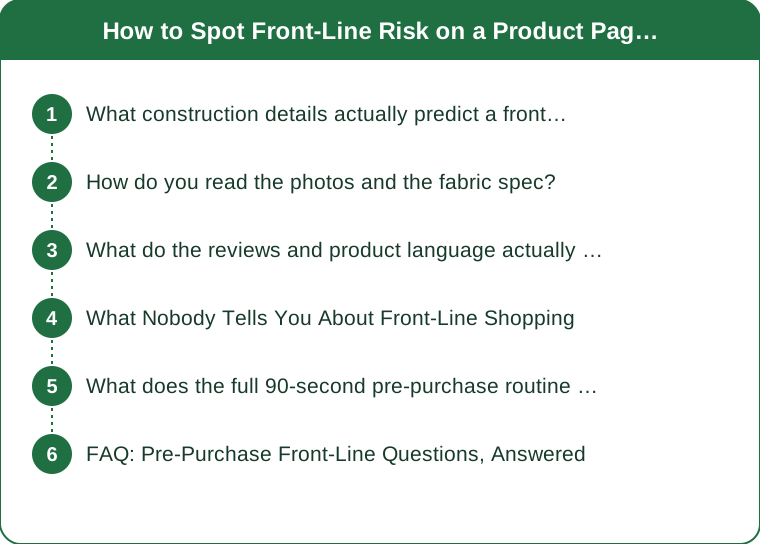
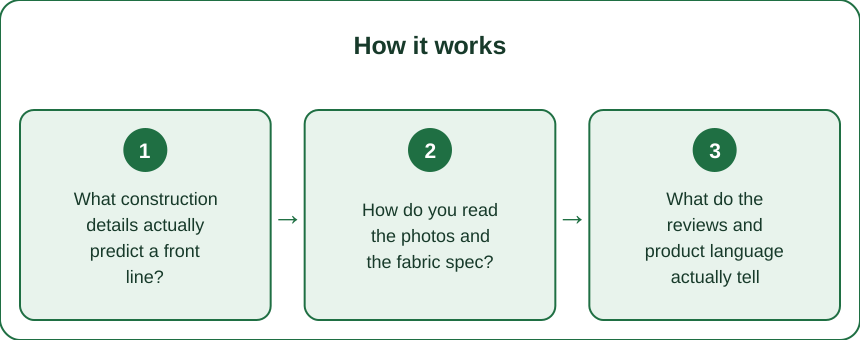
What construction details actually predict a front line?
One seam layout causes most of the problem, and product pages reveal it if you know where to look.
The risk build is the four-seam convergence: two leg pieces joined by a vertical center-front seam that meets the horizontal crotch seams in a cross. That junction stacks fabric, sits proud of the body, and creates both the vertical ridge and the puckering that reads as a line through anything fitted. It is the cheapest way to sew a legging, which is why it dominates the budget tier — but price is not a safe proxy, because plenty of premium pairs still use it.
The safe build is the gusset: a diamond- or triangle-shaped panel set into the crotch, which reroutes the seams outward so nothing converges at center front. Product pages signal it three ways — flat-lay photos showing the diamond panel, the word gusset or gusseted in the details list, or interior shots in the image carousel. A true seam-free front goes further, knitting or cutting the front as one piece; the phrases to trust are no front seam, seam-free front rise, and one-piece front.
Seam finish is the secondary read: flatlock stitching (visible as flat parallel stitch lines) lies flush and quiet, while overlocked seams stand taller. And a wide V-shaped or crossover waistband panel at the front rise often does double duty, floating fabric over the zone entirely.
None of this requires trust in marketing — it is visible geometry. Which is why the photography section matters most.
How do you read the photos and the fabric spec?
Like an inspector, not a shopper — the gallery is evidence and so are its omissions.
Zoom the front-rise photo at full resolution. On a well-lit standing front shot, a center-front seam is visible as a faint vertical line below the waistband; a gusseted front shows clean uninterrupted fabric. If the fabric is light-colored, the read is easy; on black, drag the brightness up or check the lighter colorways of the same style — construction is identical across colors, so inspect the palest colorway even when buying black.
Audit what the gallery avoids. Brands with clean front construction photograph it straight-on, close, in light colors — it is a selling point and they spend it. Pages where every front view is cropped at the hip, angled to the side, shadowed, or shot only in black are not accidents of art direction. Absence of the front-rise photo is itself a data point, and a strong one.
Then read the fabric line as a camouflage rating. Thickness and surface do the hiding: mid-to-heavyweight knits, matte finishes, textures (rib, jacquard, marl, crinkle) all scatter light and blur whatever geometry exists underneath. The broadcast fabrics are the thin, smooth, high-sheen compression knits — every contour amplified, seam included. The practical rule: a mediocre seam layout in a thick matte rib often wears cleaner than a decent layout in thin gloss. Fabric weight in gsm, where listed, is the shortcut — the higher end of the legging range hides more.
Video beats stills when offered: a try-on clip’s walking frames show whether the front rise moves smooth or puckers, which no static photo fully proves.
What do the reviews and product language actually tell you?
The reviews are a database of exactly your question — searched correctly.
Use the review search box (or ctrl-F the page) for three terms: “front,” “seam,” and “camel.” Reviewers name this issue in plain language when it exists, and the pattern matters more than any single review — three independent mentions across colorways is a verdict; one mention in a sea of praise is noise, possibly a sizing-down situation (an over-stretched pair invents lines a correctly sized one would not have). Note the reviewer’s stated size and the color they bought when weighing it.
Silence is weaker evidence than presence, but on a style with hundreds of reviews, zero mentions of the front zone is meaningful — this is not a shy topic among leggings reviewers.
On the brand’s own language, sort claims into engineering versus adjectives. Engineering claims name checkable features: gusseted, seam-free front, flat-seam construction, smooth front rise, high-density knit. Adjectives name feelings: sculpting, flattering, second-skin, confidence — pleasant and unfalsifiable. A page long on adjectives and silent on construction earned its silence; the buttery-soft leggings category in particular spans both excellent gusseted builds and four-seam crosses under identical vocabulary, so the softness claim tells you the hand-feel and nothing about the geometry.
Size charts add the last review-adjacent read: brands listing rise measurements and fabric stretch percentages are measuring things, which correlates with engineering elsewhere. Vibes-based charts correlate the other way.

What Nobody Tells You About Front-Line Shopping
The same style is not the same construction forever. Brands quietly revise builds between production runs — a beloved style’s “they changed it” reviews often mark a real gusset-to-cheaper-cross revision, which is why re-ordering last year’s holy grail still deserves the ninety-second check, and why the most useful reviews are the recent ones, sorted newest first.
Rise height changes the stakes more than people account for: a high-rise pair holds its front panel firmly against the body, keeping whatever seam exists pressed flat and stationary, while lower rises let the junction sit exactly at the flex point where fabric folds when you sit or drive. The identical construction reads worse in the lower rise — so front-line-sensitive shoppers gain a full extra margin just by defaulting toward high-rise cuts, independent of everything else on the checklist.
Color strategy is the cheap insurance nobody prices in: the same borderline construction that shows in light gray disappears in black, deep navy, espresso, and busy prints. If a style passes four checks but wobbles on one, buying it in the darkest colorway converts a maybe into a safe purchase; the light colorways are for styles that pass everything.
And the styling escape valve exists for the pairs already in the drawer: longline tops, tied overshirts, bike-short layering under sheer styles, and the front-panel skort hybrids all neutralize a marginal pair — worth remembering before returns, since a fine legging with one flaw sometimes just needs a job reassignment rather than a refund.
What does the full 90-second pre-purchase routine look like?
Run it in order — each check can end the evaluation early, which is the efficiency.
Seconds 0–20, construction scan: details list and flat-lay photos for gusset, seam-free front, flatlock, one-piece front. A named gusset plus flat seams is a strong pass; an unmentioned construction moves you to the photos with suspicion.
Seconds 20–50, photo inspection: zoom the front rise on the lightest colorway; check whether front views exist at all; watch the try-on video’s walking frames if offered. Clean visible front in light fabric — pass. No front views anywhere — treat as a fail unless reviews rescue it.
Seconds 50–70, review search: “front,” “seam,” “camel,” sorted newest. Three-plus corroborating mentions — walk away regardless of everything else; the crowd has already run your experiment.
Seconds 70–85, fabric and rise check: weight and finish for camouflage rating, rise height for stakes, stretch percentage for the size-down trap.
Seconds 85–90, the decision rule: two or more strong passes and zero review flags — buy, in your true size. One wobble — buy dark. Two wobbles — buy only with free returns and squat-test on arrival in daylight. Review flags — the drawer thanks you for the pair it never met.
Keep the results: a phone note of brands whose construction passed builds into a personal safe list within three purchases, and the whole routine collapses to “buy from the list” — which was always the endgame. The yoga pants that never betray you are a research project exactly once.
FAQ: Pre-Purchase Front-Line Questions, Answered
Does price predict front-line risk at all?
Weakly. Budget tiers use the four-seam cross more often, but plenty of premium pairs still run center-front seams under expensive fabric, and several affordable brands lead with gusseted seam-free builds as their whole pitch. Construction details predict; price gestures. The ninety seconds applies at every price point — arguably more at the top, where the disappointment costs triple.
Can I run these checks shopping in person?
Faster, even: flip the pair inside out and look at the crotch construction directly — diamond gusset panel versus converging cross answers in two seconds — then stretch the front panel over your hand under store light for the sheerness-and-seam read. The fitting-room squat with your phone camera at side angle completes what no product page fully guarantees.
Are seam-free or 3D-knit leggings automatically safe?
Mostly for seams, not universally for the zone — a true one-piece knit front eliminates the seam ridge, but very thin seamless knits can still contour closely enough to read lines of their own, especially stretched a size down. Seamless plus adequate fabric weight plus correct sizing is the actual safe formula; the word alone is two-thirds of it.
What single change most reduces my front-line returns?
Statistically for most shoppers: defaulting to high-rise, gusseted styles in darker colorways from a brand already on your pass list — that stack removes every major risk factor at once. If forced to pick one habit only, it is the review search for “front” and “seam” — thirty seconds that outsources the try-on to a hundred prior buyers who already took the photos you cannot.
TL;DR:
- Construction is destiny: gusseted and seam-free fronts pass; the four-seam center-front cross is the risk build — and product pages reveal which one you are buying.
- Read the photography like evidence: zoom the lightest colorway’s front rise, and treat a gallery with no straight-on front views as a signal in itself.
- Search reviews for “front,” “seam,” and “camel” sorted newest; three corroborating mentions ends the evaluation, and recent reviews catch quiet construction revisions.
- Stack the odds — thicker matte or textured fabric, high rise, dark colorways, true size — and keep a pass list so the research compounds into a safe-brand shortlist.
Run the ninety-second routine on the pair currently sitting in your cart. Whichever way it rules, it just outperformed the last three try-on lotteries — and the drawer of one-wear mistakes stops growing tonight.
See It in Motion
Seen here: Super High Waist Embossed Yoga Leggings with Inner Pocket — shop it on bubblelime.com
Keep Reading
This article is for general informational and styling purposes only. Fit, sizing, and product availability may vary.