Why Does the Front Seam Appear Mid-Workout But Not at the Start?
Quick Answer: Knit fabric relaxes as body heat and repeated stretching work on it, so a legging that fit closely at the start sits slightly looser and thinner-stretched by mid-session. Add moisture, which reduces opacity, and gusset migration from repeated hip flexion, and the seam that was invisible in the changing room becomes visible around minute thirty.
You checked in the mirror before you left. It was fine.
It is fine at the start of every workout. That is the tell.
This is general information, not medical advice.
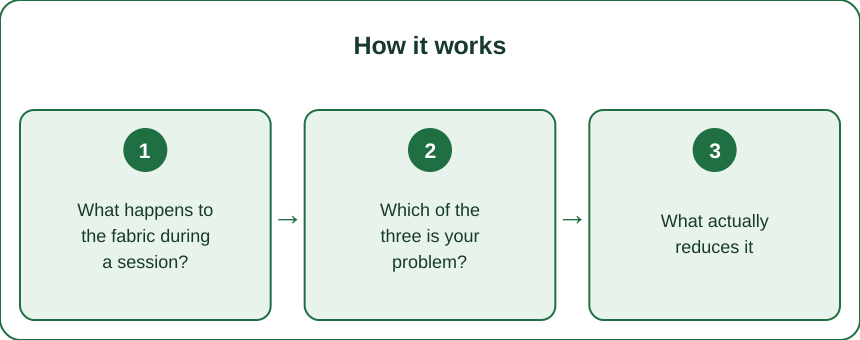
What happens to the fabric during a session?
Three separate changes, arriving together.
Relaxation under heat and load. Knit fabrics with elastane hold their shape through the recovery of the elastic fibres, and that recovery is temperature-sensitive. As body heat raises the fabric temperature over twenty or thirty minutes, the knit becomes slightly more compliant. It stretches further for the same force, which means the fabric across the front is thinner-stretched than it was when cold.
Thinner-stretched fabric is more transparent and conforms more closely to whatever is underneath, including seams.
Moisture. Sweat changes the optical properties of fabric substantially. Wet fibres transmit more light than dry ones, which is why any fabric appears darker and more see-through when damp. The front and inner thigh are among the earliest areas to hold moisture in most people.
Mechanical migration. Repeated hip flexion — squats, lunges, running, cycling — gradually shifts the gusset and the front seam from where they started. A gusset that sat neatly centred at the start can rotate or ride forward, bringing the seam into a more visible position.
None of these is a defect. All three are properties of stretch knit doing its job.
Why is it worse in some sessions than others?
Heat and sweat volume, mostly. A hot studio class produces all three effects faster and more strongly than a cool weights session of the same length.
Which of the three is your problem?
They have different signatures, and knowing which one you have determines the fix.
If it appears gradually and evenly, and the fabric feels looser generally by the end, it is relaxation. This points at fabric composition and recovery quality — and it tends to get worse over a garment’s life as the elastane degrades.
If it appears suddenly once you are properly sweating, and it is worse in hot conditions, it is moisture. This is more about fabric weight and colour than about cut.
If it appears after a specific movement — deep squats, a run, cycling — and the whole gusset feels off-centre, it is migration. This is a fit and construction issue, and it is the most fixable of the three.
A useful diagnostic: check at three points — before, at twenty minutes, and at the end. Where the change appears tells you which mechanism you are dealing with, and it takes no extra effort.
Can it be more than one?
Often it is all three, which is why it seems to arrive from nowhere. But usually one dominates, and addressing the dominant one is enough to move it below the threshold where you notice.
What actually reduces it
For relaxation: choose fabrics with a higher elastane content and a denser knit, and note that fabric weight is the most reliable predictor available. Heavier fabrics — where brands publish it, generally in the higher grams-per-square-metre range — relax less and stay opaque under more stretch. Retiring pairs that have lost recovery matters too; a legging that no longer snaps back is past the point where any styling fix helps.
For moisture: darker colours and heavier fabrics, and avoiding the light heathered greys that are worst for this. A brushed or textured surface scatters light and hides more than a smooth one at the same weight.
For migration: this is where cut does the work. A properly shaped diamond or triangular gusset stays put far better than a flat seam, and a higher rise anchors the whole garment so there is less to migrate. Waistband quality matters here more than most people expect — a waistband that slides downward during a session drags everything with it.
And one thing that helps all three: fit at the size that is close but not maximally stretched. A legging worn at the top of its stretch range has no margin, so any relaxation or moisture pushes it straight past the visibility threshold. Sizing up one is a real option for people who keep hitting this.
Do compression leggings solve it?
Often, because they combine denser fabric with a higher rise and better construction. The trade-off is that they are less comfortable for low-intensity or long-duration wear.
Myth vs Fact: mid-workout seam visibility
Myth: It means the leggings are too small. Fact: Sometimes, and just as often it is a fabric or construction issue at the correct size. Sizing up helps when the problem is stretch margin; it does nothing for a poorly shaped gusset or a light fabric.
Myth: Seamless leggings solve it. Fact: Seamless construction removes the seam and often uses lighter, more sheer knit to achieve it. Many people find seamless pairs less visible at the seam and more visible overall — a different problem rather than a solved one.
Myth: If nobody has said anything, it is not happening. Fact: Nobody is going to mention it, which is why people run for months on a pair they would have replaced immediately if they knew. The mid-session check in a changing room mirror is the only reliable feedback available.
Myth: Washing causes it. Fact: Washing well is protective — cool water, no fabric softener, air drying. What causes it is heat, which is why tumble drying is the fastest way to destroy the recovery that keeps a legging opaque.
Myth: It is the same in the studio mirror as in daylight. Fact: Overhead studio lighting and daylight from behind produce very different results. Backlighting is the worst case and the one you cannot see yourself — which is worth remembering for outdoor sessions in low autumn sun.
FAQ: Front Seam Questions, Answered
How do I check without asking someone?
Phone camera, in a changing room, mid-session. A photo from a few steps back under overhead light shows what a mirror at close range does not. It feels ridiculous and it is the only accurate method.
Does the underwear I wear change it?
Yes, considerably — seamless styles reduce the number of lines competing for visibility, and matching the colour to the legging reduces contrast. This is a bigger factor than most seam-focused advice acknowledges.
Should I stop buying light-coloured leggings?
Not necessarily, but treat them as a different category with a shorter usable life and a higher fabric-weight requirement. Light colours are genuinely harder and there is no styling around it.
How long should a pair last before this starts?
With regular use and proper washing, quality pairs commonly hold their recovery for a year or more. If a pair starts showing this within a few months, the fabric was under-specified rather than mistreated.
Does the weather matter?
More than expected. Cooler autumn sessions delay the relaxation effect, so a pair that failed in August may be fine in October — and then fail again in a heated studio. The variability people find confusing usually traces back to temperature.
TL;DR:
- Three things change during a session: fabric relaxes with heat, moisture reduces opacity, and the gusset migrates.
- Check before, at twenty minutes, and at the end — where it appears tells you which one you have.
- Heavier, denser fabric with good recovery fixes relaxation; darker and textured fixes moisture; a shaped gusset and higher rise fix migration.
- Do not wear a legging at the top of its stretch range — leave margin.
- Heat destroys recovery, so skip the tumble dryer entirely.
The changing room check before you start is the one that tells you least. The one at minute thirty is the only one that reflects how the garment actually performs.
This is general information, not medical advice.
See It in Motion
Seen here: High Waist 8” Yoga Shorts — shop similar styles on bubblelime.com
Keep Reading
This article is for general informational and styling purposes only. Fit, sizing, and product availability may vary.