Why Light-Colored Leggings Show Front Seams More Than Dark Ones - and Which Ones Do Not
Quick Answer: Light fabric reflects more light, so any change in thickness or angle - which is what a seam is - casts a visible shadow. Dark fabric absorbs light and hides the same shadow. The construction that stays invisible in pale colors: a gusseted crotch with no center front seam, flatlock or bonded seams instead of overlocked ones, and a denser knit that does not thin under stretch. Color alone is not the problem; light color plus a center front seam is.
Which means you can absolutely wear pale leggings - you just have to shop on construction, not on shade.
And the test that predicts it takes about fifteen seconds.
Why does the same seam disappear in black?
Because visibility depends on contrast, and contrast depends on how much light comes back to your eye.
A seam is a place where two or more layers of fabric overlap, creating a ridge. That ridge has a different thickness and sits at a slightly different angle from the flat fabric around it.
On light fabric, the flat surface reflects a lot of light, and the ridge casts a small shadow. A shadow against a bright background is high contrast - clearly visible.
On dark fabric, the flat surface reflects little to begin with, so the shadow has almost nothing to contrast against. Same physical ridge, no visible difference.
Two additional factors in pale colors:
- Stretch thinning. As fabric stretches over a curve it gets thinner, and thin light fabric transmits more light - so stretched areas glow slightly while seams stay opaque. The contrast increases exactly where the garment is under most tension.
- Sheen. A shiny finish on a pale color amplifies everything, since specular reflection makes surface angle changes far more obvious. Matte pale fabric hides seams substantially better than shiny pale fabric.
Which construction stays invisible in pale colors?
Sorted by how much difference each makes.
1. A gusset instead of a center front seam. A gusseted crotch uses a diamond or triangular panel, which eliminates the four-way seam intersection at the center front entirely. This is the single most important feature and it is the one people rarely check.
2. Flatlock or bonded seams. Flatlock stitching butts fabric edges together instead of overlapping them, producing a much lower ridge. Bonded or welded seams use adhesive rather than thread and are effectively flat - the best option for pale colors, though usually found at higher price points.
3. A dense knit that stays opaque. Look for a listed weight if the brand publishes one; heavier fabric, roughly 250 gsm and up, thins far less under stretch.
4. Matte finish. Avoid glossy or high-sheen pale fabrics.
5. A subtle pattern or heather. Heathered and marled fabrics break up the surface so shadows have less uniform background to contrast against. This is why heather gray hides seams far better than a solid pale gray.
What is the fifteen-second in-store test?
This works better than any spec sheet.
Stretch the fabric across the flat of your hand and hold it up toward a light source. Look at three things:
- How much light comes through the stretched fabric. If you can clearly see your hand, it will be sheer over a thigh under tension.
- Whether the seam area remains distinctly darker. A high difference here is what you will see on your body.
- Whether there is a visible ridge running through the center front when the fabric is relaxed.
Then, in the fitting room, do the actual test: squat. Fully. Sitting and standing hide the problem because the fabric is not at maximum stretch. A deep squat in bright fitting room light shows you what the garment does in a workout.
Check in the brightest light available, not a dim corner. Store lighting is often deliberately flattering, so if a pale pair looks fine in store, check again at a window before removing tags.
And take a photo with flash. Flash photography is the harshest possible test and it is exactly what happens at a group class or a race.

Myth vs Fact: pale leggings
Myth: Light-colored leggings are always see-through. Fact: fabric density decides this, not color. A dense 280 gsm cream legging is more opaque than a thin 180 gsm black one - the black one just hides it better.
Myth: More expensive means more opaque. Fact: correlated but unreliable. Some premium brands use very lightweight fabric deliberately for feel and breathability. Check the fabric, not the price.
Myth: Sizing up fixes sheerness. Fact: it reduces stretch tension, which genuinely helps a little. But it also loosens the fit and creates its own problems - and it does nothing about seam construction.
Myth: A longer top solves the whole thing. Fact: it covers the front seam and does nothing about the fabric at the thigh and seat, where stretch is highest. A useful workaround, not a solution.
Myth: The seam looks the same to everyone. Fact: it is far more visible in direct overhead light, in flash photos, and in daylight than in the indoor lighting where you dressed. If you check under one condition, check under daylight.
What are the best pale options if I want them anyway?
You should - the pale palette is genuinely worth wearing, and autumn is a good moment for oat, sand, and soft sage.
Prioritize in this order:
- Gusseted, seamless-front construction. Non-negotiable in pale colors.
- Heathered or marled fabric over flat solid. A soft heather in oatmeal or sage hides more than a flat cream at the same weight.
- Matte finish, always.
- Higher fabric weight. If a brand publishes gsm, aim for 250+.
- Mid or high rise with a wide band, which keeps the front panel smoother under tension.
Colors that are more forgiving: heather gray, oatmeal, taupe, soft sage, and muted clay. Colors that are least forgiving: flat white, pale pink, and light blue - the highest reflectance and the least surface variation.
And one practical note: seamless-front pale leggings tend to sell out first for exactly this reason. If you find a pair that passes the squat test, that is the pair to buy in two colors.
FAQ: Front Seam Questions, Answered
Does a gusset always mean no front seam?
Not always - some gussets still have a short center front seam, though it is far less prominent than a four-panel intersection. Look at the actual garment, or at the product photos zoomed in, rather than trusting the word alone.
Do the seams get more visible over time?
Yes. As fabric loses recovery it thins more under the same stretch, so a pair that was fine at purchase can become revealing after a year of hot washes. Cold wash and air dry.
Are seamless (knit-in-one-piece) leggings the answer?
Often, since they have no traditional seams at all. The trade is that seamless knits are frequently lighter weight, which can reintroduce sheerness. Run the same stretch-and-squat test.
TL;DR:
- Light fabric reflects light, so seam shadows have something to contrast against. Dark fabric hides the same ridge.
- Shop construction: gusseted front, flatlock or bonded seams, 250+ gsm, matte finish.
- Heathered pale fabrics hide seams far better than flat solids at the same weight.
- Squat in bright light and take a flash photo before removing tags - that is the real test.
- Sizing up helps a little; a longer top covers, it does not fix.
Pale leggings are a construction question wearing a color question’s clothes. Run the fifteen-second stretch test and the shopping gets a lot more reliable.
See It in Motion
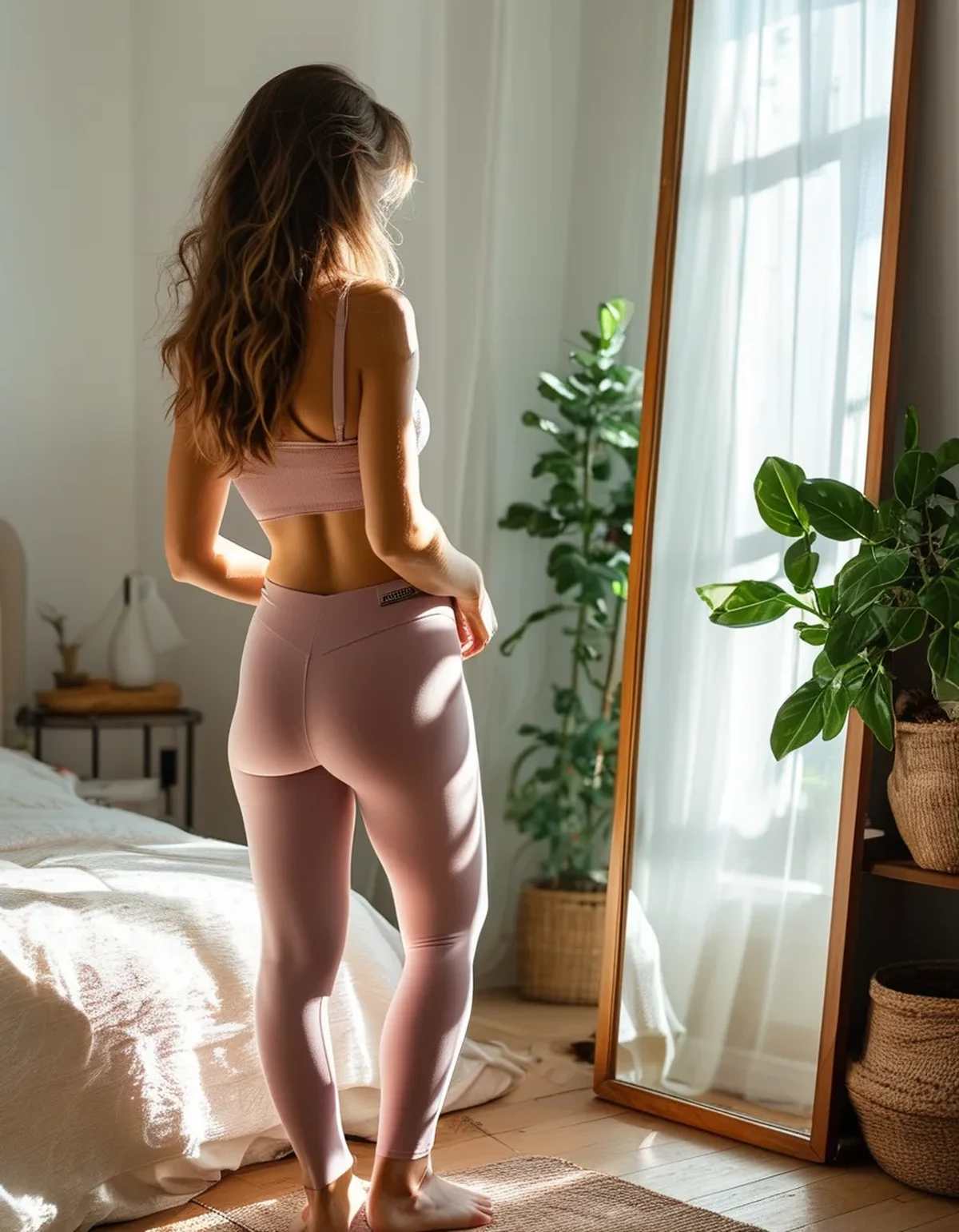
Seen here: High Waist Embossed Yoga Leggings with Side Pockets — shop it on bubblelime.com
Keep Reading
This article is for general informational and styling purposes only. Fit, sizing, and product availability may vary.